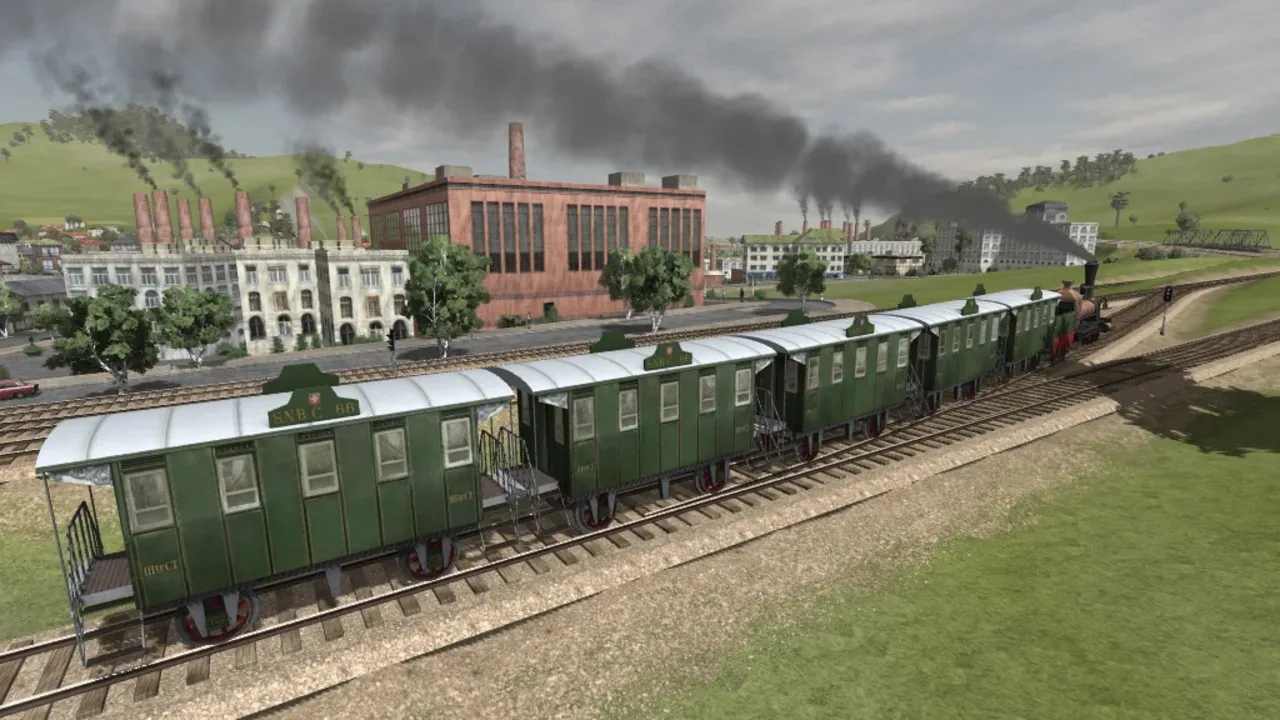
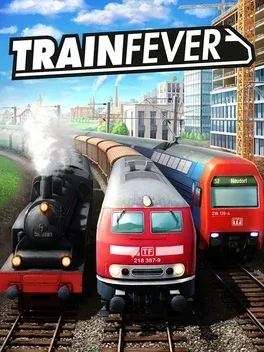
Train Fever is a transport management simulation game developed by Urban Games and released in 2014. It is the first entry in what later became the Transport Fever series. The game focuses on building and managing a complete transportation company over more than a century of industrial and technological development, starting in 1850 and progressing through different eras of transportation history.
At its core, Train Fever challenges players to design and operate efficient transport networks that connect cities, industries, and rural areas. Players begin with simple horse-drawn carriages and early steam locomotives, gradually unlocking more advanced vehicles as time progresses. The goal is to establish profitable routes that move passengers and cargo between growing cities while adapting to increasing demand and evolving technology.
The game world is procedurally generated, meaning each map is different. Cities are placed across varied terrain, and they dynamically grow based on the success of the player’s transport systems. If a city is well connected and efficiently supplied with goods and passengers, it expands into a larger urban center. Poor connectivity, on the other hand, slows development. This simulation creates a living world where transportation directly influences economic and urban growth.
A key gameplay feature is the freedom to design infrastructure without a strict grid system. Players can lay tracks, roads, and stations in flexible configurations, allowing for realistic and organic network layouts. However, this freedom also introduces challenges, such as terrain constraints and the difficulty of optimizing routes across large distances. Managing logistics, avoiding inefficiencies, and balancing costs are central to success.
The game includes multiple transport types, including trains, trucks, buses, and ships. While trains are often the backbone of long-distance logistics, road vehicles play a crucial role in feeding and distributing goods within cities. Players must carefully integrate these systems to maintain profitability and efficiency.
Economic management is another major aspect of gameplay. Each vehicle and route has operating costs, maintenance requirements, and capacity limits. Players must ensure that routes remain profitable while expanding their network strategically. Overexpansion or poorly planned infrastructure can lead to financial losses, making careful planning essential.
Visually, Train Fever features a detailed 3D world with changing seasons, realistic terrain, and evolving cityscapes. Although its graphics are now dated compared to newer titles, the simulation depth remains its strongest feature. The game’s soundtrack and ambient audio also help reinforce the feeling of managing a living transportation empire.
While the game received mixed reviews due to performance issues and interface limitations, it laid the foundation for its more refined successors like Transport Fever and Transport Fever 2. Despite its flaws, Train Fever is recognized for its ambitious simulation systems and its attempt to create a fully dynamic transport-driven world.
Transport simulation starting from 1850 to the modern era.
Procedurally generated maps with evolving cities.
Realistic city growth based on transport efficiency.
Train, road, bus, and ship transportation systems.
Free-form track and road construction (no grid system).
Dynamic passenger and cargo simulation.
Economic management with operating costs and profits.
Historical vehicles spanning over 150 years.
Expanding transport networks and route planning.
Foundation for the Transport Fever series.
5 Fragen
Noch eine Frage?
Alle FAQ ansehen