
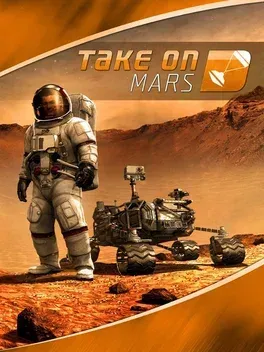
Take On Mars is a space exploration simulation game developed and published by Bohemia Interactive. Released in 2017 after an extended Early Access period, the game offers a realistic and scientifically grounded experience centered on the exploration of Mars. Combining vehicle simulation, survival mechanics, engineering challenges, and planetary exploration, Take On Mars provides players with an opportunity to experience what future missions to the Red Planet might look like.
The game features multiple gameplay modes that cater to different play styles. Players can begin by controlling robotic rovers inspired by real NASA and ESA missions. These vehicles are used to navigate Martian terrain, conduct scientific experiments, gather samples, and complete mission objectives. The rover missions emphasize careful planning and realistic operation, requiring players to manage power systems, navigation, and scientific instruments while exploring the planet's surface.
As players progress, the game expands beyond robotic exploration and introduces human missions. In the astronaut-focused campaign, players become one of the first humans to land on Mars. This mode combines exploration with survival elements, requiring players to manage oxygen, food, energy, and other essential resources. Establishing and maintaining a functioning habitat becomes critical as players attempt to survive in one of the harshest environments imaginable.
The campaign mode presents a narrative-driven journey inspired by real-world space exploration concepts. Players experience the challenges of preparing for launch, traveling through space, landing on Mars, and establishing a long-term presence on the planet. The story explores the technical and logistical difficulties involved in interplanetary travel while maintaining a strong focus on realism.
A major strength of Take On Mars is its commitment to scientific authenticity. The Martian landscape is modeled using real planetary data, creating vast deserts, rocky formations, craters, and geological features inspired by actual regions of Mars. Vehicle systems, scientific equipment, and mission procedures are designed to reflect current understanding of space exploration technologies.
Sandbox mode provides additional freedom, allowing players to create custom missions and experiments. Users can deploy vehicles, build scenarios, and explore Mars without the restrictions of campaign objectives. This flexibility makes the game appealing to players who enjoy experimentation and creative problem-solving.
The game also includes construction and resource management systems. Players can expand their Mars base with additional modules, power generators, storage facilities, and life-support equipment. Efficient management of resources is essential for long-term survival and successful exploration.
Visually, Take On Mars delivers expansive planetary environments that capture the isolation and scale of Mars. The atmosphere, terrain, and lighting help create an immersive experience, while realistic vehicle models and equipment enhance authenticity. Sound design further reinforces the feeling of being alone on a distant world.
Although the game appeals primarily to simulation enthusiasts and space exploration fans, it offers a unique experience rarely found elsewhere. Its combination of realistic science, survival mechanics, engineering challenges, and planetary exploration creates an engaging and educational journey.
For players interested in the future of human space travel, Take On Mars provides one of the most detailed and immersive Mars exploration simulations available.
Realistic Mars exploration simulation.
Control robotic rovers inspired by real missions.
Human astronaut campaign with survival mechanics.
Scientifically inspired Martian landscapes.
Base construction and expansion systems.
Resource and life-support management.
Sandbox mode with custom mission creation.
Realistic spacecraft and vehicle operation.
Exploration of vast open Martian environments.
Educational and science-focused gameplay.
5 Fragen
Noch eine Frage?
Alle FAQ ansehen