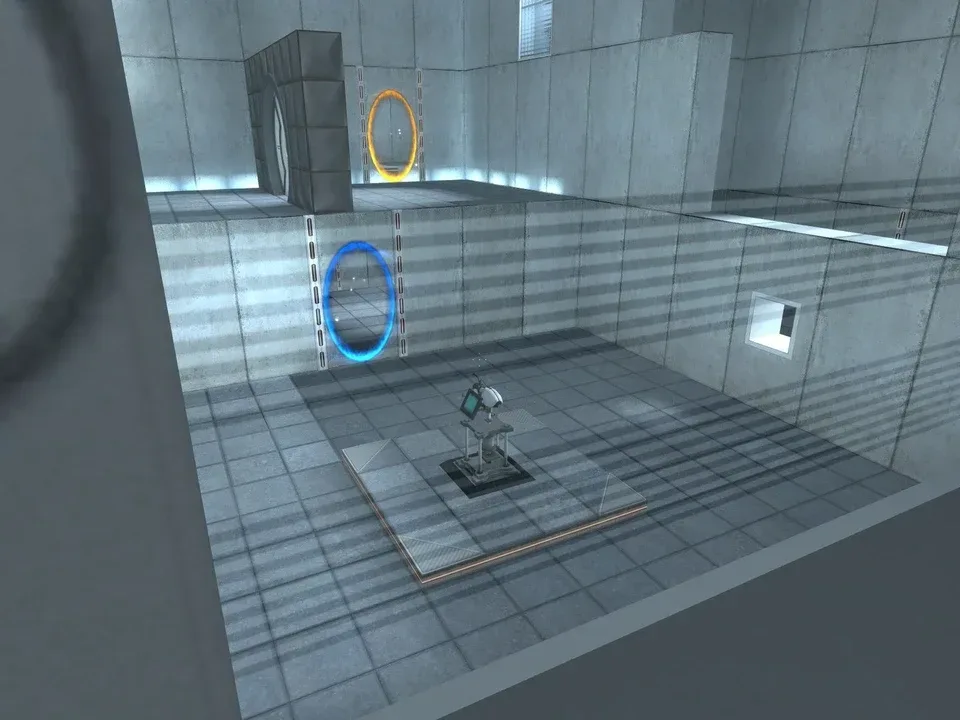

Portal is a first-person puzzle-platform game developed by Valve Corporation and released in 2007 as part of The Orange Box. Widely regarded as one of the most innovative games ever created, Portal revolutionized puzzle design through its unique portal mechanics, intelligent storytelling, and minimalist approach to gameplay.
Players assume the role of Chell, a silent protagonist who awakens inside the mysterious Aperture Science Enrichment Center. Guided by an artificial intelligence known as GLaDOS, Chell is instructed to complete a series of increasingly complex test chambers designed to evaluate problem-solving abilities.
The game's central mechanic revolves around the Aperture Science Handheld Portal Device, commonly known as the Portal Gun. This device allows players to create two interconnected portals on compatible surfaces. Entering one portal instantly transports the player or objects to the other. Using these portals, players must navigate obstacles, solve environmental puzzles, and reach designated exits.
A fundamental concept in the game is the conservation of momentum. Objects and players maintain their speed when traveling through portals, enabling creative puzzle solutions involving jumps, launches, and precise movement. This simple rule forms the foundation for increasingly sophisticated challenges throughout the game.
The test chambers gradually introduce new mechanics and hazards. Players encounter energy balls, moving platforms, timed switches, turrets, toxic substances, and other obstacles that require strategic portal placement. The difficulty curve is carefully designed, ensuring that each new concept builds naturally upon previous lessons.
While Portal initially appears to be a straightforward puzzle game, its narrative unfolds subtly through environmental storytelling and dialogue. As players progress, inconsistencies begin to appear within the testing facility, raising questions about the true nature of the experiments and the intentions of GLaDOS.
One of the game's most iconic aspects is its writing. GLaDOS delivers a constant stream of sarcastic, humorous, and increasingly unsettling commentary that adds personality to every test chamber. Her dialogue became legendary among players and remains one of the most celebrated examples of character writing in gaming.
The atmosphere evolves dramatically as the story progresses. Sterile laboratory environments eventually give way to hidden maintenance areas and abandoned sections of the facility, revealing secrets about Aperture Science and its history. This shift transforms the experience from a pure puzzle game into a memorable narrative adventure.
Visually, Portal uses the Source Engine to create clean, minimalist environments that keep the focus on puzzle-solving. The simple design ensures that important gameplay elements remain easy to identify while maintaining a believable scientific setting.
The game's sound design enhances both humor and immersion. Mechanical sounds, environmental effects, and GLaDOS's voice work contribute significantly to the atmosphere. The ending song, Still Alive, became particularly famous and remains closely associated with the franchise.
Despite its relatively short length, Portal had a massive impact on the gaming industry. Its innovative mechanics, memorable storytelling, and elegant puzzle design influenced countless games that followed.
Innovative portal-based puzzle mechanics
Physics-driven gameplay and momentum systems
First-person puzzle-solving experience
Memorable AI antagonist GLaDOS
Clever environmental storytelling
Progressive and challenging test chambers
Dark humor and iconic dialogue
Creative use of space and movement
Atmospheric scientific setting
Highly influential game design
5 Fragen
Noch eine Frage?
Alle FAQ ansehen