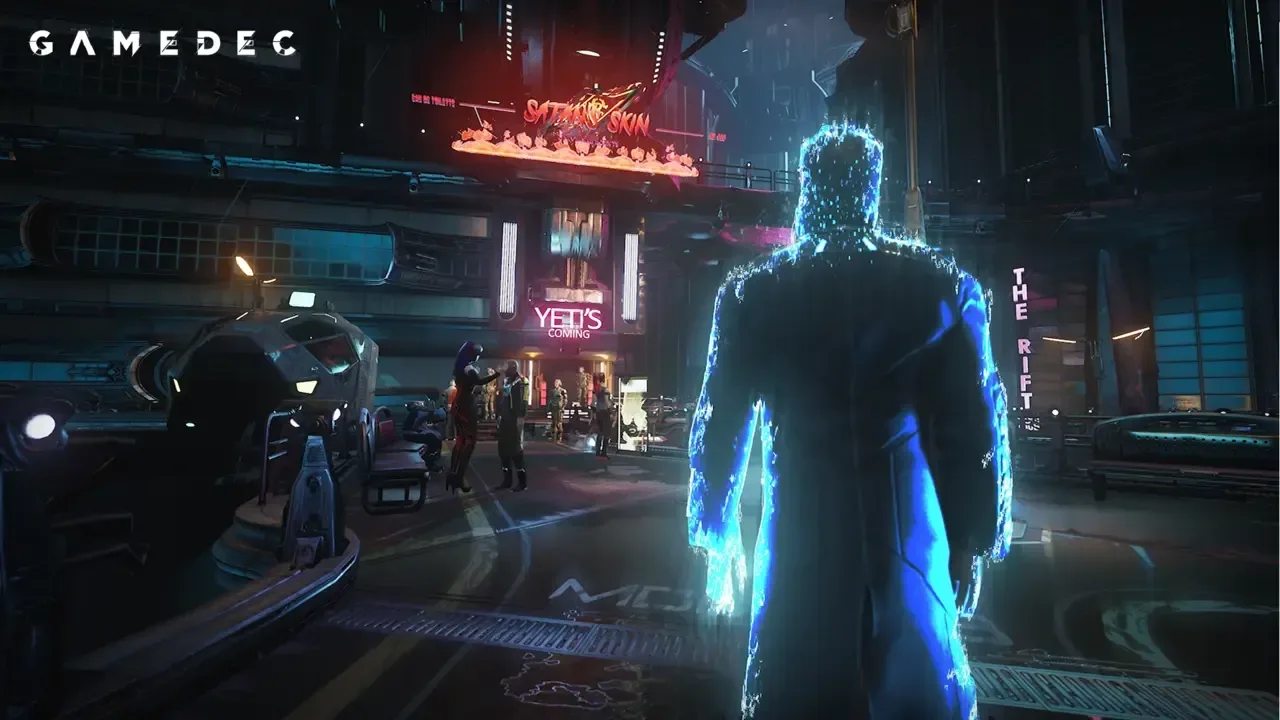

Gamedec is an isometric cyberpunk role-playing game developed by Anshar Studios. Set in the 22nd century, it explores a future where virtual reality games are deeply integrated into everyday life, creating entire digital societies where people work, live, and sometimes commit crimes.
The player takes on the role of a “Gamedec,” a professional detective specialized in investigating crimes that occur inside virtual worlds. These crimes can involve hacking, scams, identity theft, emotional manipulation, or even psychological harm caused within immersive simulations. Unlike traditional RPG protagonists, the Gamedec does not fight enemies physically—instead, they rely on intelligence, observation, dialogue, and decision-making.
Gameplay is built entirely around investigation and narrative choice. Players explore different virtual environments, each representing a distinct genre of game world, such as fantasy kingdoms, cyberpunk cities, farming simulators, or survival games. Each world has its own rules, cultures, and social systems, making every case feel unique.
Progression is driven by dialogue trees, evidence collection, and decision-making. Players gather clues by examining environments, talking to NPCs, analyzing data, and making deductions. The choices made during investigations directly influence how cases unfold and how characters respond.
A key system in Gamedec is its “character build” based on traits rather than combat stats. Players develop their detective by investing in personality-driven attributes such as Empathy, Logic, Intuition, and Rhetoric. These traits unlock different dialogue options and approaches to solving problems, allowing multiple solutions to the same case.
The game emphasizes moral ambiguity. There are rarely clear “right” or “wrong” answers, and players must often decide between conflicting perspectives, such as corporate interests, personal emotions, or ethical considerations. These decisions can affect relationships, case outcomes, and even future missions.
Each virtual world visited during the game acts like a self-contained narrative ecosystem. Some worlds are governed by strict rules and economies, while others are chaotic or experimental. This variety allows the game to explore different genres and storytelling styles while maintaining its central detective theme.
Visually, the game uses an isometric perspective with detailed environments that reflect its cyberpunk setting. Neon-lit cities, digital landscapes, and stylized VR environments create a contrast between reality and simulation.
The narrative explores philosophical themes such as identity, free will, digital existence, and the consequences of living in fully immersive virtual worlds. It questions what it means to be “real” when lives inside games can feel as meaningful as physical reality.
There is no combat system in Gamedec. Instead, tension comes from investigative pressure, branching dialogue, and the consequences of player choices. This design reinforces its focus on thinking, deduction, and storytelling rather than action.
Cyberpunk detective RPG setting
Investigation-based gameplay (no combat)
Multiple virtual worlds with unique rules
Deep branching dialogue system
Trait-based character progression (Logic, Empathy, etc.)
Moral choice-driven narrative
Non-linear case solving
Isometric cyberpunk visuals
Complex storytelling and deduction mechanics
Exploration of identity and virtual reality themes
5 Fragen
Noch eine Frage?
Alle FAQ ansehen