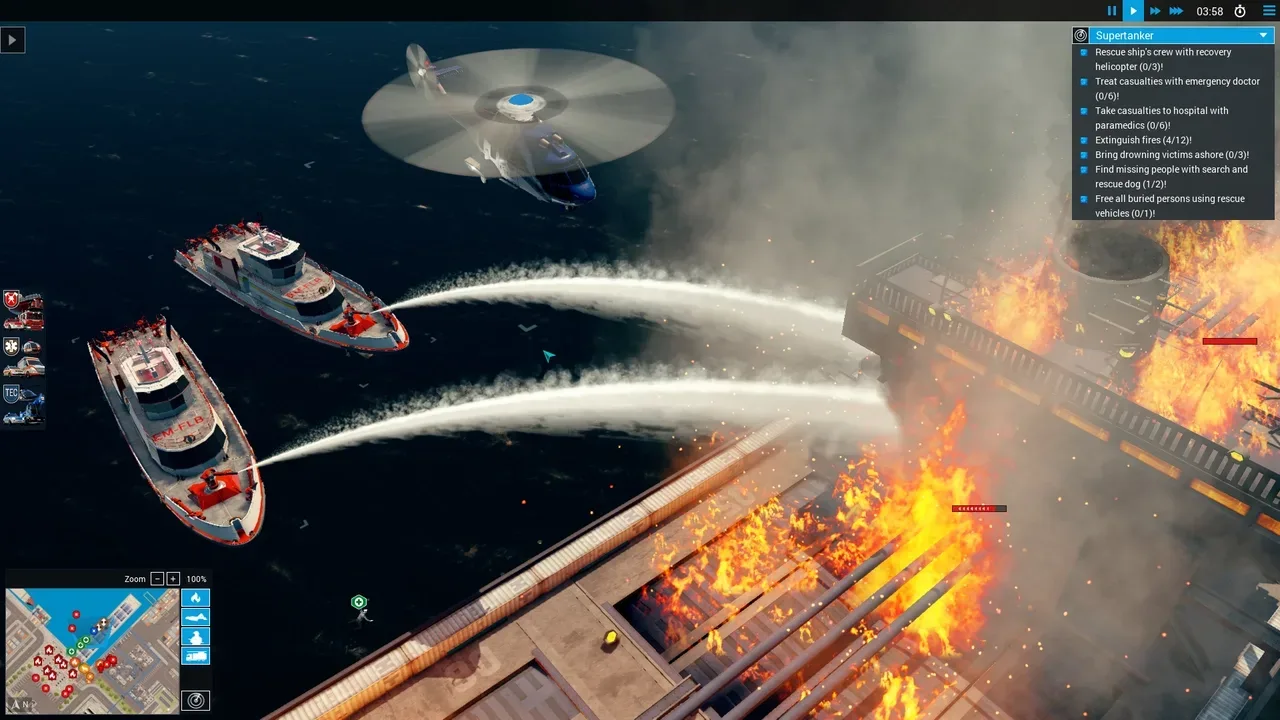

EMERGENCY 20 is a real-time strategy and rescue simulation game developed by Sixteen Tons Entertainment and published by Promotion Software. Released to commemorate the twentieth anniversary of the long-running EMERGENCY franchise, it combines content from previous entries with updated visuals and new missions designed around emergency response operations.
Unlike traditional strategy games that focus on warfare, EMERGENCY 20 places players in charge of civilian emergency services. The objective is not to defeat enemies but to save lives, contain disasters, protect property, and maintain public safety. Players coordinate multiple rescue units while responding to complex and often unpredictable situations.
The game includes a wide variety of emergency scenarios. Players may be tasked with extinguishing building fires, responding to traffic accidents, rescuing trapped civilians, handling hazardous material leaks, controlling riots, treating injured victims, or managing large-scale natural disasters. Each mission requires quick decision-making and efficient resource management.
A core aspect of gameplay is controlling different emergency service branches. Firefighters are responsible for extinguishing fires and performing rescues, police officers maintain order and secure dangerous areas, paramedics provide medical treatment and transport injured civilians, while technical and support units handle specialized rescue operations.
Resource allocation is critical in EMERGENCY 20. Players must decide which units to deploy, where to position them, and how to prioritize objectives when multiple incidents occur simultaneously. Poor decisions can allow emergencies to spread and create additional casualties.
The game features both campaign missions and free-play modes. Campaign scenarios often include scripted disasters with specific objectives, while free-play generates dynamic incidents that challenge players to manage ongoing emergencies across large maps. This variety helps provide long-term replayability.
Vehicle management is another important component. Players control a wide range of authentic emergency vehicles including fire engines, ambulances, police cars, rescue helicopters, technical support trucks, and specialized equipment vehicles. Each serves a unique role during operations.
The visual presentation uses an overhead perspective that allows players to monitor large areas while maintaining control of individual units. Detailed urban environments include roads, buildings, industrial complexes, public spaces, and infrastructure that can become affected during emergencies.
One of the strengths of the EMERGENCY series is its focus on realistic emergency procedures. While simplified for gameplay purposes, many scenarios require players to follow logical rescue processes such as securing accident scenes, extinguishing fires before rescue attempts, or stabilizing victims before transportation.
Multiplayer modes allow cooperative gameplay, enabling friends to coordinate emergency responses together.
Cooperation becomes especially valuable during larger disasters where multiple incidents demand simultaneous attention.
As an anniversary edition, EMERGENCY 20 includes a collection of missions inspired by previous games in the franchise, allowing long-time fans to revisit classic scenarios with updated technology and presentation.
The game's challenge comes from managing chaos under pressure. Emergencies often escalate if not handled quickly, forcing players to balance immediate threats with long-term consequences. Effective planning, rapid reactions, and proper unit coordination are essential for success.
Real-time emergency response strategy gameplay
Control firefighters, police, paramedics, and rescue units
Campaign and free-play game modes
Large variety of disaster and rescue scenarios
Authentic emergency service vehicles
Firefighting, rescue, and medical operations
Resource and personnel management
Cooperative multiplayer support
Anniversary content from previous EMERGENCY games
Urban disaster management simulation
5 Fragen
Noch eine Frage?
Alle FAQ ansehen