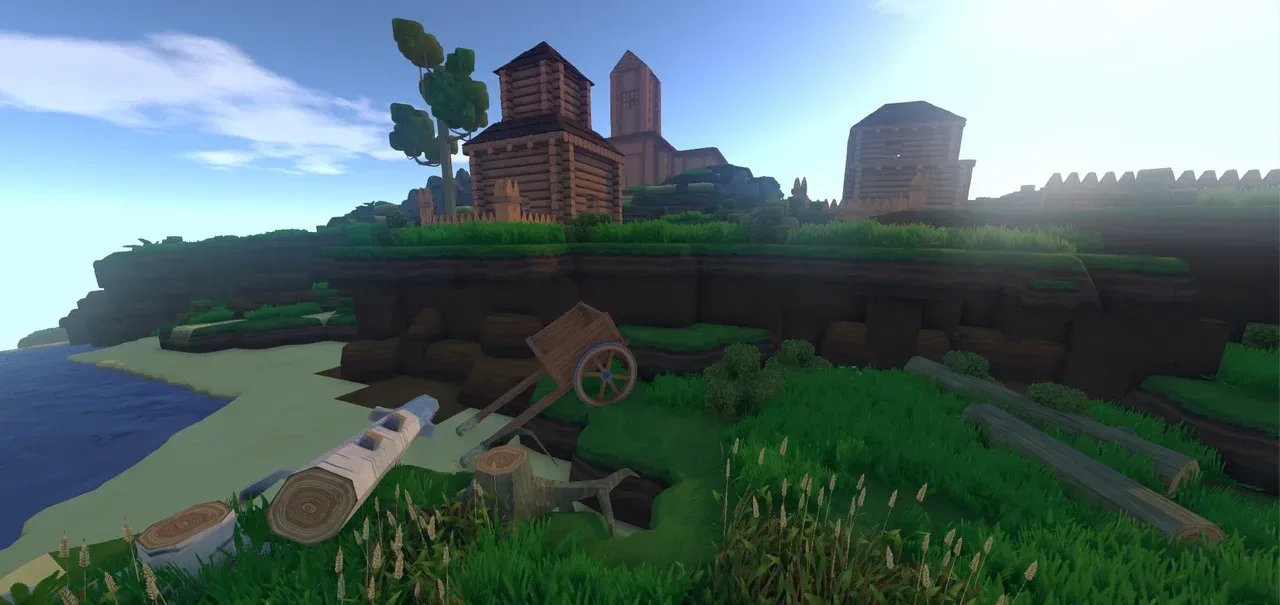

Eco is a simulation, survival, and world-building game developed and published by Strange Loop Games. Unlike traditional survival games that focus solely on resource gathering and construction, Eco places environmental sustainability at the center of its gameplay, creating a unique blend of ecology, economics, politics, and cooperative civilization building.
The game takes place on a fully simulated planet threatened by a massive asteroid. Players are given a limited amount of time to develop their civilization, advance technology, and ultimately build the means to destroy the asteroid before it impacts the world. However, achieving this goal is not as simple as rapid industrialization. Every action taken by players affects the environment, creating a delicate balance between progress and sustainability.
At the beginning of a game, players start with primitive tools and basic skills. They gather resources, construct shelters, harvest food, and establish the foundations of society. As the world develops, players specialize in professions that contribute to the broader community.
One of the defining features of Eco is its deep specialization system. Players choose professions such as farming, mining, engineering, cooking, carpentry, tailoring, hunting, or research. No individual player can efficiently master every profession, encouraging cooperation and economic interdependence.
The game's ecosystem is fully simulated. Animals, plants, water systems, pollution levels, and resource availability all respond dynamically to player actions. Excessive hunting may drive species toward extinction, while unchecked pollution can damage habitats, contaminate water sources, and reduce agricultural productivity.
Environmental management becomes increasingly important as technology advances. Industrial machinery and large-scale resource extraction accelerate development but may create harmful ecological consequences. Players must carefully evaluate the long-term effects of their decisions.
Economics also play a major role. Players can establish businesses, create currencies, operate marketplaces, and trade goods and services with one another. This player-driven economy often becomes a central aspect of multiplayer servers.
A unique political system allows players to create governments, pass laws, establish regulations, and vote on policies. Communities can introduce taxes, environmental protections, zoning restrictions, and other legislation to guide societal development. This system transforms the game into a social experiment where political decisions have tangible consequences.
Construction mechanics allow players to build detailed homes, factories, towns, roads, bridges, and infrastructure projects. Architectural creativity is supported by a wide variety of building materials and decorative options.
Scientific advancement drives long-term progression. Research unlocks new technologies, tools, machinery, and capabilities that help society grow. Reaching the technological level required to stop the asteroid requires cooperation between multiple professions and industries.
Visually, Eco features a colorful and vibrant world with a semi-realistic art style. The environment evolves over time, reflecting the impact of player decisions. Forests can disappear through overharvesting, pollution can spread across landscapes, and ecosystems can recover if properly protected.
The game supports both single-player and multiplayer experiences, though its systems are particularly effective in cooperative communities where players collaborate toward shared goals.
Fully simulated ecosystem and environment
Civilization-building and societal development
Asteroid threat creating long-term objective
Deep profession and specialization system
Player-driven economy and trading
Government, laws, and political systems
Environmental sustainability mechanics
Extensive building and construction tools
Scientific research and technological progression
Cooperative multiplayer-focused gameplay
5 Fragen
Noch eine Frage?
Alle FAQ ansehen